
English version beta
Board of Directors
In accordance with the Company’s Articles of Association, the Board of Directors shall consist of seven to nine directors, each serving a three-year term and eligible for re-election. The Board currently comprises nine directors, including four independent directors. The Chairman is elected by the Board and is responsible for presiding overboard meetings, overseeing internal operations, and representing the Company externally. To strengthen oversight and enhance corporate governance, the Board has established both an Audit Committee and a Compensation Committee in accordance with Article 14 of the Securities and Exchange Act.
Board Diversity Policy
When appointing directors, the Company evaluates candidates not only on their operational, management, and leadership capabilities, but also on the diversity of their backgrounds and expertise. The Company has adopted diverse policies aligned with its operational scale, business model, and long-term development strategy to ensure a well-balanced and effective Board.
A. Board Diversity Policy Framework
Pursuant to the Company’s Corporate Governance Code of Practice, the following principles apply:
a. Board Structure
The size and structure of the Board are determined based on the Company’s stage of development, operational needs, and the shareholding structure of major shareholders.
b. Diversity Criteria
Board composition emphasizes diversity and includes, but is not limited to, the following dimensions:
-
Basic Qualifications and Values: Gender, age, nationality and cultural background.
-
Professional Knowledge and Skills: Professional background (e.g., law, accounting, finance, industry, marketing, technology), professional competencies and industry experiences.
c. Required Competencies
Board members are expected to possess the knowledge, skills, and integrity necessary to fulfill their duties. Collectively, the Board is expected to demonstrate the following capabilities:
-
Operational judgment
-
Accounting and financial analysis
-
Business management
-
Risk and crisis management
-
Industry knowledge
-
International market perspective
-
Leadership
-
Strategic decision-making
B. Board Diversity Objectives
The Company’s specific diversity objectives include balanced age distribution, directors who also serve as company executives shall not exceed one-third of Board seats and a comprehensive mix of professional expertise.
C. Current Board Diversity Status
Following the 2015 Annual General Meeting, the Company has nine directors (including four independent directors), consisting of eight individual directors and one institutional director. All directors are Taiwanese nationals.
Age Distribution
○ 41–50 years: 1 director (11.1%)
○ 51–60 years: 3 directors (33.3%)
○ 61–70 years: 4 directors (44.4%)
○ 71–80 years: 1 director (11.1%)
Gender Diversity
○ Male directors: 6 (66.6%)
○ Female directors: 3 (33.3%)
Female directors currently represent one-third of the Board, reflecting the Company’s commitment to gender diversity.
Executive Representation
Three directors (33.3%) also hold employee or executive positions, which remains below one-third of total Board seats, in line with the Company’s diversity objectives.
Professional Expertise
The Board collectively brings extensive experience across business management, finance, securities, accounting, law, and industrial technology. Each director contributes distinct expertise, ensuring a balanced and diverse perspective on Board decision-making.
Ongoing Commitment
The Company will continue to strengthen Board diversity by enhancing both basic qualifications and professional expertise, in alignment with its operational structure and strategic development needs. This ongoing commitment ensures the Board maintains a broad range of perspectives and competencies to support effective governance and sustainable growth.
List of Board Members:

Succession Planning for Board Members and Key Management
Board Succession Planning
The Company has established a formal succession planning mechanism for Board members to ensure continuity, stability, and effective governance. Directors are selected through a candidate nomination system in accordance with the Company’s Articles of Association and Corporate Governance Code of Practice. Board composition is determined based on the Company’s business scale, operational needs, and major shareholding structure, while also emphasizing diversity in background, expertise, and experience.
To support long-term succession, the Company maintains a Director Candidate Database, with candidates evaluated based on the following criteria:
-
Personal integrity, sense of responsibility, innovation, and decision-making ability, consistent with the Company’s core values, and possessing professional knowledge and skills that contribute to business management.
-
Relevant industry experience aligned with the Company’s operations and strategic direction.
-
The ability to contribute to a collaborative, diverse, and company-oriented Board, strengthening collective effectiveness.
-
Overall Board expertise that covers key domains, including corporate strategy and management, accounting and taxation, finance, and law.
To ensure Board effectiveness, the Company has established a Board Performance Evaluation Policy. Evaluations assess areas such as:
-
Alignment with corporate goals and mission
-
Understanding of roles and responsibilities
-
Participation in operations and oversight
-
Internal communication and relationship management
-
Professional competence and development
-
Internal control effectiveness
-
Expression of independent and constructive opinions
Evaluation results are used as an important reference for future director selection and succession planning, ensuring continuous improvement in governance quality.
Key Management Succession Planning
Key management personnel at the associate level and above are responsible for major operational and management functions within the organization, with designated representatives at each management level to ensure continuity.
Key management candidates are required to:
-
Possess the necessary professional skills and management experience
-
Demonstrate values and business philosophy aligned with the Company’s corporate culture
To develop future leaders, the Company implements structured succession development programs, including:
-
Professional development and corporate governance training
-
Participation in Board meetings and internal key management meetings, when appropriate
-
Project-based on-the-job training to strengthen practical management capabilities
The Company conducts annual employee performance evaluations to assess performance, identify development needs, and align individual growth with organizational expectations. Evaluation results serve as a key reference for management succession planning and talent development, ensuring a stable and sustainable leadership pipeline.
Audit Committee
To enhance the Board’s oversight responsibilities and strengthen internal control mechanisms, the Company established its Audit Committee in June 2019. The Audit Committee is composed entirely of independent directors, with at least one member possessing accounting or financial expertise, in compliance with applicable regulations. Independent directors serve three-year terms and are eligible for re-election. The Convener of the Audit Committee is responsible for presiding over meetings and representing the Committee externally. Records of Audit Committee meetings and each member’s attendance are disclosed in the Company’s Annual Report for transparency and reference.
Compensation and Remuneration Committee Members

The Company maintains effective communication mechanisms between independent directors, the internal audit manager, and external accountants to ensure transparency in financial and operational oversight.
1. Communication Mechanisms
The Company has appointed independent directors who also serve as members of the Audit Committee. The internal audit manager regularly attends meetings of both the Audit Committee and the Board of Directors, reporting on the implementation status of the annual audit plan and submitting audit results for review by independent directors.
For significant audit matters, communication may also be conducted through written correspondence, email, or telephone discussions as needed. Overall, communication between independent directors and internal audit functions remains effective and well maintained.
2. Communication Records
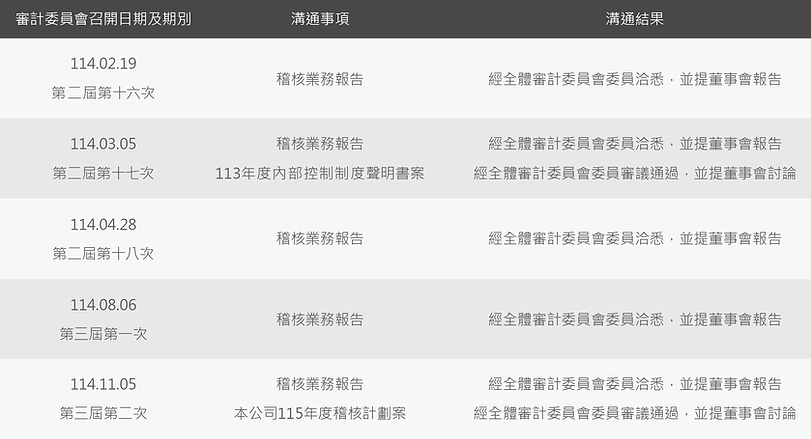
The communication between independent directors and the internal audit manager during 2025 is summarized as follows:
3. Communication Between Independent Directors and External Accountants
Independent directors hold at least one annual communication meeting with the Company’s certified public accountants through the Audit Committee or the Board of Directors. The accountants report audit results of the financial statements and other legally required matters, while the Audit Committee reviews the accountants’ appointment, independence, and suitability.
During these meetings, the external accountants report to the independent directors on:
-
The results of audits of the Company’s financial statements
-
Key audit findings and observations
-
Other matters required by applicable laws and regulations
The Audit Committee also reviews and evaluates the appointment, independence, and professional competence of the external accountants to ensure audit quality and objectivity.

Compensation and Remuneration Committee
The Company established the Compensation and Remuneration Committee in April 2016 to strengthen governance and ensure fairness, transparency, and alignment between compensation and performance.
The Committee is responsible for performing the following duties with the duty of care of a prudent manager and submitting its recommendations to the Board of Directors for review and approval:
-
Establishing and periodically reviewing the Company’s policies, systems, standards, and structures for performance evaluation and compensation of directors and managerial officers.
-
Periodically evaluating and determining the compensation of directors and managerial officers in accordance with the Company’s operating performance, long-term strategy, and governance principles.
The Committee’s meeting schedule and the attendance record of each member are disclosed in the Company’s Annual Report for transparency and reference.
